At ZFoam we have shown on multiple occasions our commitment to the circular economy, to the increasing use of more sustainable and environmentally friendly foams, and to minimize, and even reduce, the carbon footprint and other derived impacts from our activity.
To continue with our commitment, we have led a pioneering initiative in our sector, by developing a tool capable of offering all our clients the Life Cycle Analysis (LCA) of the products we manufacture for them. .
Its purpose is to provide first-hand numerical and objective information on the environmental impact derived from the manufacture of the product, which can also be compared with those of other alternative materials, such as cardboard or plastic.
From now on, when we deliver an order, we offer the possibility of sending the LCA of your specific product, so that you have reliable and numerical information about the environmental impact. This indicator is becoming more significant, especially if we talk about packaging.
What exactly do we mean when we talk about Life Cycle Analysis?
The Life Cycle Analysis evaluates all the possible environmental impacts that are found throughout the supply chain of a product or service. The objective is to evaluate the potential impact on the environment of a product, process or activity throughout its life cycle: from the extraction of raw materials, to the waste disposal after the end of its useful life.
The information provided by the LCA is much more complete and exhaustive than what we obtain from the calculation of the carbon footprint, for example, since this represents one of the 18 environmental impacts in total that the tool takes into account.
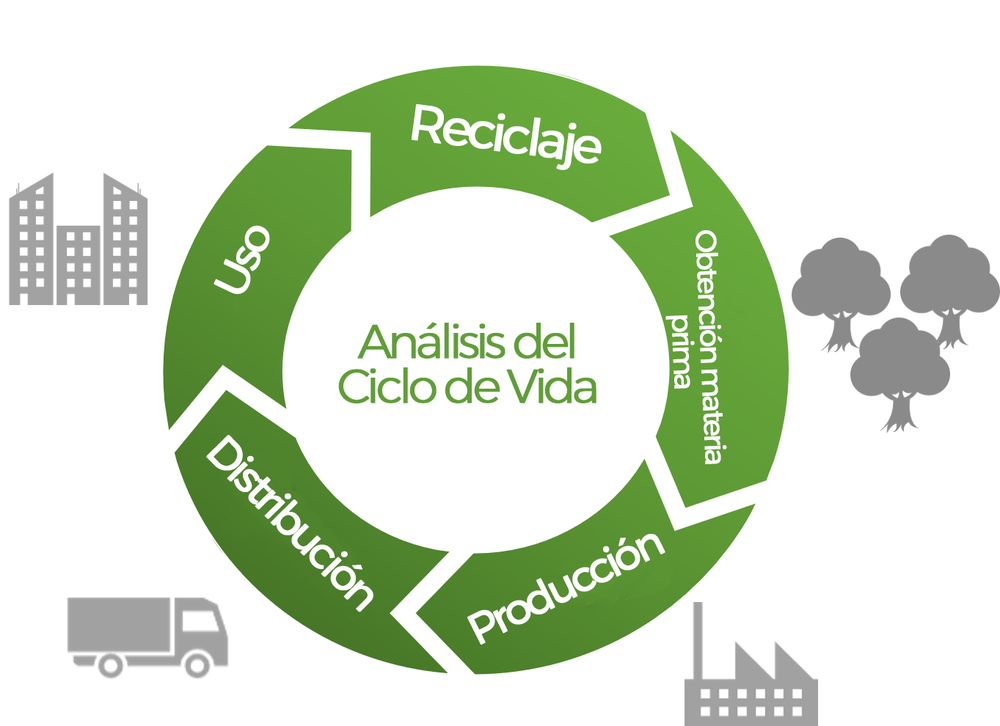
How do we calculate it?
To calculate the Life Cycle Analysis of our products we have had the support of the Circe Foundation, a technology center that has been in charge of developing this LCA calculator.
To do this, Circe has used a series of primary data provided from ZFoam, and internationally recognized databases, commonly used by all types of organizations to calculate their LCA.
The LCA calculation is made from some input data (information about the product whose impact we want to know about), taking into account the information from the databases, to obtain some output results, which correspond to the information we are looking for.
These results are very interesting and revealing, since they show that some of our foams, especially those that we manufacture from forest residues or biomaterials, have an even lower impact than other alternatives that are popularly better considered.
In our next post, we’ll talk more about input data and output results.