We recently announced the release of our new general catalogue of foams and insulating materials, a complete guide containing more than 80 materials, which we have created as a professional reference tool.
While our last post about our new catalogue was devoted to the section on Azote® and Zotek®, we now focus on the section about our reticulated and non-reticulated polyolefin foams PN/PT, PTPK, PR, LJ/EVJ, PEVA and PNR.
Types of reticulated and non-reticulate polyolefin foams
As a reminder, the basic difference between reticulated and non-reticulated polyolefin foams is their production process (the former involves a physical and chemical reaction called reticulation, while the latter involves the use of pressurised gas to expand them without the need for reticulation) and density. Reticulated foams come in densities of 25 kg/m3 and above, while non-reticulated foams densities come within a range of 20–150 kg/m3.
We have divided these foams into types to make them easier to identify and compare their properties. There are different types of reticulated foams:
- PN / PT– both stand out for their physical reticulation and excellent surface quality, although PN foams are more resistant to impacts, and PT foams show better performance when compressed. These foams can also include varying degrees of fire-retardant additives. They are widely used in industry and construction.
- PTPK– these foams have a semi-closed cellular structure and become closed-cell foams when compressed. They stand out for their softness, elasticity, ability to recover their original shape and their resistance to chemical agents. They are particularly suitable for air and water seals.
- PR– these stand out for their chemical reticulation and their good mechanical properties, which make them suitable for a large number of uses, including the manufacture of articles of comfort and for thermal and acoustic insulation.
- LJ / EVJ– these foams have an extremely fine microcellular structure and come in a wide range of special colours, a stand-out being ‘deep black’, which is ideal for presentation packaging.
Non-reticulated foams include:
- PNR– in addition to its range of densities (20–150 kg/m3), PNR foams are characterised by their different levels of antistatic properties and for their ease of transformation, making them suitable for packaging solutions.
- PEVA– these foams are made from high-density EVA. Their excellent performance and high level of versatility make this an ideal material for packaging and leisure applications.
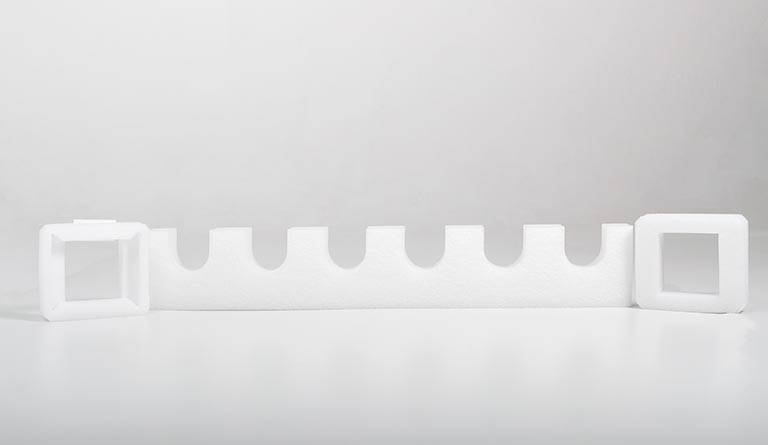
Sectors for use
The foams we have described are commonly used in a wide variety of sectors, including the automotive, rail transport, packaging, construction, sport, healthcare, food and household appliance sectors. In fact, there are practically as many uses for this group of technical foams as there are sectors in the economy because there are specific materials capable of simultaneously catering to more than one need.
Forthcoming posts will present the remaining sections of the new general catalogue of foams, which you can download here.
We also remind you that you can obtain a catalogue in hard copy with real samples of each foam so that you can appreciate their feel and texture first-hand. To receive it, all you need to do is contact us.
New catalogue of ZFoam technical foams:
-
Azote Foams (Part 1)
-
Reticulated and non-reticulated polyolefin foams (Part 2)