When a medical device leaves the laboratory or assembly line, it faces its most delicate stage: transport. A bump, continuous vibration or temperature variation can alter calibrations, mark casings, or break components or products. At ZFoam, we design and transform technical foams that turn a suitcase, box or container into customised protection for medical devices and their supply chain.
Our approach is practical: we choose the material, adjust the density and thickness, define the insert geometries (bed, cells, cradle, separators), and apply controlled processes (2D/3D waterjet, CNC, die cutting, laminations, thermoforming). The result is repeatable, clean, and traceable solutions.
Why is foam essential in the transport of medical devices?
Vibrations, shocks and temperature control
The risk is not only the ‘big impact’; micro-movements that generate slack, shocks that exceed the elastic range of the material and due to vibration are also important. Added to this are variations in temperature and humidity during transit or storage. Therefore, the design of the internal protection must consider:
- Cushioning and load distribution: select foam with the appropriate modulus and compressibility to dissipate energy without collapsing.
- Dimensional stability and low compression set: the insert must retain its shape after multiple uses.
- Surface compatibility: avoid migration, marks or detachment; facilitate quick cleaning.
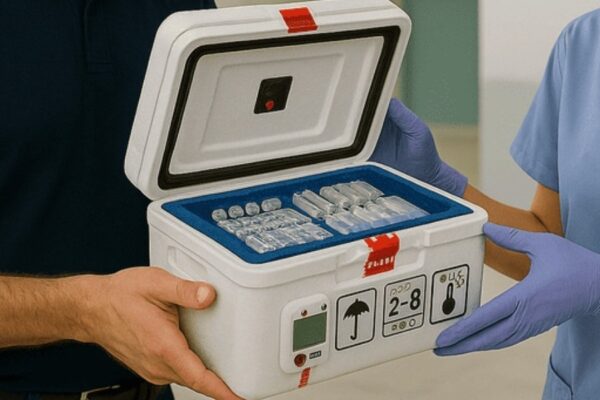
- Thermal control where appropriate: combinations with isothermal containers.
With well-designed foam inserts, we reduce damage and speed up assembly (the equipment immediately ‘fits’), improving set-up times in the operating theatre, laboratory or field.
Regulations and best practices you should be aware of (GDP, ISO 13485)
Packaging for medical devices must comply with the organisation’s requirements: GDP (Good Distribution Practice), ISO 13485 (quality management systems for medical devices) or ISO 11607 (packaging for terminally sterilised medical devices). Not every insert is sterile packaging, but it does need to facilitate:
- Traceability and identification (colour coding, laser engraving, QR/Datamatrix).
- Repeatability (tight tolerances, process control) and cleanliness.
- Technical documentation for customer validation and change control.
Foam types and how to choose the right one
Before going into detail, here is a visual comparison of the most common types of foam and their use in medical equipment.
| Foam type | Key properties | Benefits | Common devices/uses |
|---|---|---|---|
| Cross-linked PE (Plastazote® / Evazote®) | Closed cell; low water absorption; dimensionally stable | High cushioning; lightweight; easy to clean; FR/metallised options | Surgical kits, instruments, portable diagnostics, prosthesis protectors |
| Flexible PU | Open cell; high shock absorption | Excellent cushioning; good energy dissipation; economical | Protective fillers, interior padding, equipment not exposed to moisture |
| ESD – CN – AS PE (antistatic / dissipative / conductive) | Closed cell; antistatic, ESD, CN properties | Protects sensitive electronic parts; reduces discharge failures | Plates, sensors, electronic modules for medical devices |
| PE / PNR foams (isothermal support) | Closed cell; very good thermal insulation | Lightweight; economical; useful as an outer container | Isothermal packaging for consumables, reagents and accessories (with PCM/ice packs) |
Note: Final suitability depends on the device, applicable regulations and customer validations.
Cross-linked polyethylene foams: Plastazote® and Evazote®
Closed cell (physically foamed) PE/EVA cross-linked foams are the standard for precision inserts. They offer low water absorption, clean surface, excellent CNC/waterjet machining and stability. FR/FM grades and two-colour versions are available for visual inspection. Typical applications: surgical kits, instruments, prosthesis/implant protection and portable diagnostics.
Other foams such as polyurethane and sustainable options
- Flexible PU (open cell): great cushioning for shock absorption; ideal as a ‘soft’ layer when there is no exposure to moisture.
- ECO options: lines with recycled/certified or bio-based content, and new-generation foamed papers to reduce footprint and facilitate recyclability of the entire packaging.
Benefits of foams
- Mechanical protection: they cushion impact and vibration and eliminate slack.
- Weight and logistics cost: lightweight materials that reduce fuel consumption and freight.
- Reusability: designed for multiple cycles, with low compression set.
- Compatibility: clean surfaces, low VOC emissions and good chemical resistance.
- Total customisation: custom geometries, colour coding, laser engraving/printing for traceability and kit control.
Our experience in ZFoam: customised solutions
Materials and manufacturing processes that make the difference
We integrate material selection and transformation in-house. We combine 2D/3D waterjet, CNC, die cutting, thermoforming and laminations to achieve the exact fit. Fast prototyping allows us to validate geometries, tolerances and ergonomics of use (grips, cable channels, ‘click’ areas). If necessary, we integrate mixed layers (ESD + comfort, or isothermal + support) and technical adhesives.
Benefits for your business
- Menos daños y RMA: insertos que reparten cargas y evitan micromovimientos.
- Faster set-up: each part has its own ‘cradle’; intuitive assembly and repackaging.
- Easier compliance: audit- and documentation-oriented design.
- Brand and reputation: careful presentation, clear identification and a sense of quality.
Give your supply chain an extra layer of security
Transport is just as critical as the design of the device itself. If you need foam inserts that combine protection, speed of use and compliance, tell us about your case. At ZFoam, we turn your need into prototype that can be validated and an industrialisation plan ready for production.
Let us talk? Our technical team can review your device, suggest materials and send you a cutting layout with clear deadlines and costs.