We know that a military vehicle must withstand hostile terrain with extreme temperatures, vibrations that hinder operation, the ever-present risk of ballistic impacts or the invisible threat of improvised explosive devices (IEDs)… where crew safety is the top priority, the challenges are immense.
In this scenario, the difference between success and failure depends on the strength and reliability of the equipment. The materials used to build and equip these vehicles are not a minor detail; they are crucial!
You may wonder, what can ‘simple’ foams contribute to an environment as complex and technologically advanced as defence? Well, more than you might think. We are talking about advanced materials, the result of research and engineering, designed and customised to provide specific solutions to the very specific needs of the military sector.
Protection Systems for Armoured Vehicles
When it comes to military vehicles, protection and survival are a priority. How can our naturally lightweight foams help save lives and protect critical equipment in extreme situations? The key lies in the engineering of the material and the design of the solution:
- Explosion Mitigation (Mines and IEDs): We use technical foams with extremely high energy absorption capacity, such as high-density polyurethanes (PU) or special viscoelastic formulations, intelligently integrated into:
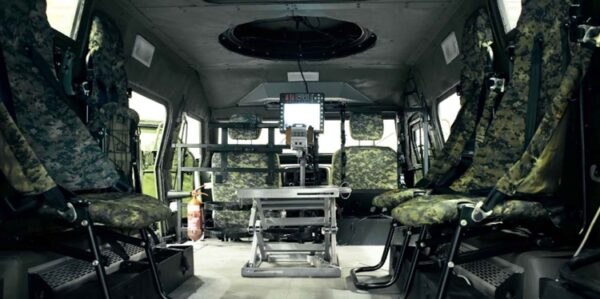
- Anti-Mine Seats / Blast Seats: We collaborate in the design and manufacture complex components (often using CNC milling or thermoforming) that form part of the structure of these seats. Their function is crucial: to dissipate and manage the brutal G-forces transmitted to occupants during an explosion, protecting particularly the spine.
- Floating floor systems: We implement high-density, resilient foam components that act as decoupling elements between the floor of the passenger compartment and the vehicle chassis. This helps to isolate the crew from the shock wave caused by explosions under the hull.
- Secondary ballistic protection (Spall Liners): A ballistic impact on the main armour can generate fragments (spall) that are projected at high speed into the interior, posing a deadly danger. Our solution? We develop customised spall liners , often combining layers of foam (such as high-density polyethylene – PE – or PU) with other advanced materials (aramids, composites). The foam provides lightness and a fundamental ability to effectively trap and slow down these dangerous fragments.
- Internal impact padding: During evasive manoeuvres, the crew can suffer blows against the internal structures of the vehicle. To minimise this risk, we design and manufacture customised padding panels (using foams such as cross-linked PE or EVA), adapted to the interior geometry of the passenger compartment by milling or thermoforming. They protect the crew and increase passive safety.
Optimisation of vehicle performance and comfort
An effective military vehicle must be robust, agile, reliable and comfortable for its crew, even on long missions and in adverse conditions.
- Thermal and acoustic insulation: Can you imagine operating in a desert at 50°C or in a tundra at -30°C? Or trying to communicate with the deafening noise of the engine and the environment? Our foams are excellent insulators
- Thermal control: We use materials such as melamine foams (lightweight and fire-resistant) or closed-cell PU and PE to line the passenger compartment, equipment compartments or even the engine compartment (with high thermal resistance foams). They help maintain stable operating temperatures, reduce the load on the air conditioning and can help reduce the vehicle’s thermal signature.
- Acoustic comfort: We apply specific foams (melamine, open-cell PU) to absorb noise, improving the intelligibility of internal communications, reducing crew fatigue and lowering the vehicle’s external acoustic signature. We can even laminate these foams with heavy barriers for extra insulation.
- Strategic weight reduction: In military mobility, every kilogram counts. Replacing heavier components with technical foam solutions (without compromising protection or functionality) directly contributes to improving vehicle agility, increasing payload and optimising fuel efficiency. Foams are, by definition, lightweight materials.
- Ergonomics and comfort for the crew: A comfortable and safe crew is a more effective crew.
- Seats and padding: Seat components using PU foams of different densities and firmness’s, optimising postural comfort, vibration absorption and durability, with the option of specific lumbar support.
- Ergonomic components: Armrests, headrests, handles and other contact elements in semi-rigid foams (such as integral PU or EVA) that improve comfort and safety during operation.
- Safe floors: Floor coverings made of foams (EVA, PE) that can incorporate anti-slip textures, cushion impacts and reduce fatigue on long missions.
- Reliable sealing and watertightness: Protecting the interior of the vehicle and sensitive equipment from dust, water, humidity and other contaminants is vital. We manufacture customised gaskets and seals using closed-cell foams (such as PE or cellular EPDM, the latter with excellent weather resistance) for hatches, doors and electronic equipment boxes, ensuring integrity in any environment.
Comprehensive Solutions for Military Vehicle Protection
We are experts in a wide range of materials (polyethylene, polyurethane, EVA, melamine, silicone) and processing technologies (2D and 3D CNC milling, thermoforming, lamination, bonding).
At ZFoam, we understand your challenges and offer comprehensive solutions that guarantee safety, optimise operational performance, reduce thermal and acoustic signatures, and provide essential comfort so that the crew can focus on the mission.
If you would like to learn more about our technical solutions, please visit our ZFoam Defence page, or contact our team.