Packaging problems often arise when the design of the protective packaging is treated as a secondary phase of the project. Damage during transport, rework, returns or downtime are, in many cases, caused by an incomplete assessment of logistical and operational risks and by solutions that fail to account for the actual behaviour of the part during handling and transport.
Foam protective packaging should be understood as a passive mechanical system, designed to immobilise the part, distribute loads, absorb energy and maintain these properties consistently over time.
This guide addresses the design of industrial foam protective packaging from a technical perspective.. We could say that it is a decision framework for designing reliable, repeatable and scalable protection solutions
What is industrial protective packaging and why does it frequently fail?
The aim of protective packaging is to control the movement and loads experienced by a part throughout the entire logistics chain.. This involves considering impact, vibration, compression, the environment and operational factors, rather than limiting the design to a single drop or an isolated condition.
The most common failures occur when:
- The packaging is oversized to ‘be on the safe side’, resulting in excessive rigidity.
- The design focuses solely on impact and ignores vibration or unexpected rotations.
- The geometry of the insert does not control internal movement.
- The material is selected out of habit or based on price, without functional criteria.
Well-designed packaging forms part of the industrial and logistics system; it does not act as a standalone accessory.
Step 1: Correctly parameterise the part to be protected
Any protection solution begins with a rigorous characterisation of the part. The decisions made at this stage determine the entire subsequent design.
Geometry, mass and critical points
In addition to knowing the actual external dimensions, it is essential to identify:
- Mass distribution.
- Centre of gravity.
- Structurally fragile areas.
- Areas with sharp edges, cutting surfaces or pointed areas.
- Functional surfaces that must not bear any load.
A part with irregular geometry or concentrated masses requires specific supports. Otherwise, the foam operates outside its optimal range and loses effectiveness.
Surface and finish restrictions
In many industrial applications, the damage is not breakage, but surface deterioration:
- Painted or lacquered parts.
- Optical surfaces.
- Precision-machined components.
This is where materials and configurations come into play that prevent marks, excessive friction or particle transfer during transport and handling. There are also specific foams for these particular circumstances.
Special requirements
Requirements such as the following must be defined from the outset:
- ESD protection, anti-static or conductive properties in electronic components
- Cleanliness requirements or low particle generation.
- Chemical compatibility with oils, greases or specific atmospheres.
- Foams with flame-retardant additives (FR or FM)
These factors affect both the material and the manufacturing process of the insert
Step 2: Define the actual logistics risk profile
The risk is operational, not theoretical. And it must be defined before design.
Impact and handling
Actual drops are not ideal laboratory tests. Hands, trolleys, tables, conveyor belts and changes in level are involved. Packaging must withstand real and repeated impacts, not just a single event.
Vibration and fatigue
One of the most common mistakes is to underestimate vibration. Many parts do not break due to impact, but rather due to progressive micro-degradation of the protective material. Resilience and elastic recovery are critical during prolonged transport.
Compression and stacking
The packaging must maintain its function under load:
- Stacking in the warehouse.
- Constant pressure for weeks.
- Permanent deformation of the material.
A correct design takes into account the loss of performance over time.
Environment
Temperature, humidity, dust or prolonged storage directly influence the behaviour of the foam. The environment determines which materials are suitable and which are not.
Step 3: Foam selection. Material, density and structure
The choice of material must meet functional criteria linked to the defined risk.
Materials: criteria for use
Depending on the application, the following may be used:
- Polyethylene foams (cross-linked or uncross-linked) where dimensional stability and repeatability are required.
- EVA-based foams where greater elasticity or more controlled surface contact is needed.
- Flexible polyurethanes in applications requiring soft absorption.
- High-density PE foams in returnable industrial systems requiring high durability.
The choice must be based on the function the material is to fulfil within the protection system.
Density and rigidity
Higher density does not mean greater protection. Foam that is too rigid transmits energy to the part; foam that is too soft allows movement. The balance depends on mass, geometry and the defined risk.Closed-cell vs open-cell.
Closed cell vs. open cell. Cellular structure
Closed-cell foam offers:
- Moisture resistance.
- Cleanliness.
- Particle generation.
- Dimensional stability.
Open-cell foam may be suitable for specific applications, but requires a more careful assessment of the environment and the usage cycle.
ESD protection
Electrostatic protection must be applied where there is a real risk. Its use should be based on resistivity, the environment and the packaging’s lifecycle, avoiding oversized or unnecessary solutions.
Step 4: Design of the protective insert
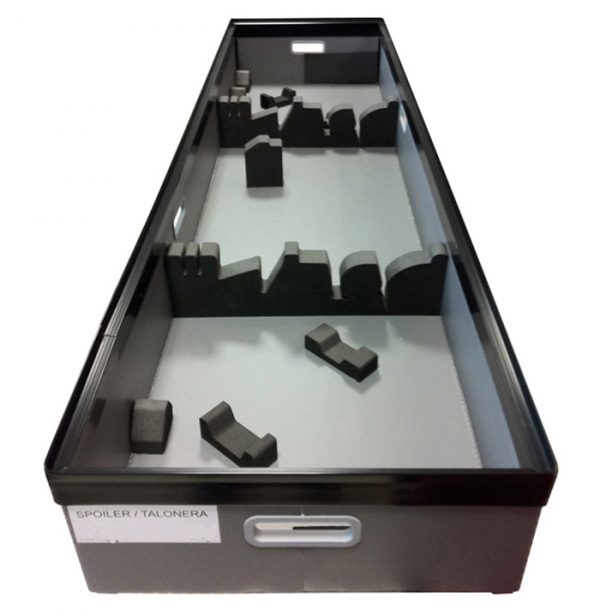
Here, the packaging ceases to be merely material and becomes applied engineering.. The insert defines the actual performance of the protection system. A good foam loses its effectiveness if the geometry is not right.
Support and locking zones
The design must:
- Control movement along all three axes.
- Distribute loads.
- Avoid stress concentrations.
The part must ‘rest’ on the insert, not float.
Tolerances and industrial repeatability
The design must function in series production, with different operators and repeated cycles. Excessively tight tolerances cause operational problems; loose tolerances allow unwanted movement.
Functional layers
In certain applications, it is advisable to separate functions:
- Structural layer that absorbs energy.
- Friction or fit layer.
- Surface layer protectING finishes.
Operations-oriented design
The packaging must facilitate work on the production floor:
- Speed of packaging.
- Visual inspection.
- Reduction of human error.
Good design improves both protection and operational efficiency.
Step 5: Packaging validation prior to scale-up
Validation confirms that the design meets the defined criteria prior to scale-up.
Selection of tests
Depending on the risk, tests may be required for:
- Impact.
- Vibration.
- Compression.
- Environmental.
Not all are always necessary. The important thing is to choose those that are appropriate or relevant to the specific application.
Acceptance criteria
Clear criteria must be defined before testing:
- What is considered valid.
- What is considered a failure.
- Which variables are measured.
Sin criterios definidos, no existe validación técnica.
Step 6: Standardisation, returnable packaging and total cost
Once the design has been validated from a technical perspective, protective packaging enters a second dimension. Its performance over time and its integration into the industrial system.
At this stage, decisions directly affect operating costs, logistical complexity and scalability. Considering standardisation, reusability and total cost allows protection to be maintained consistently throughout the packaging’s life cycle.
Reusable vs disposable packaging
El embalaje retornable tiene sentido cuando:
- There is significant volume.
- There are repeated cycles.
- Reverse logistics are managed and their viability is validated.
The assessment must be based on total cost rather than unit cost.
Maintenance and replacement
Good design allows for:
- Replacing only damaged parts.
- Maintaining performance over time.
This reduces incidents and extends the system’s service life.
Packaging families
Designing families of inserts for multiple product variants reduces complexity, standardises processes and facilitates scaling without compromising protection.
Final checklist for industrial protective packaging design
Before moving to production, the following should be defined:
- Complete characterisation of the part.
- Logistics risk profile.
- Justified selection of material and density.
- Geometry and tolerances of the insert.
- Clear validation criteria.
- Usage strategy (returnable/disposable) and maintenance.
If you are evaluating or redesigning industrial protective packaging, a technical design checklist helps ensure that no critical variables are overlooked from the outset.
When industrial protective packaging is designed using technical criteria, it ceases to be a source of incidents and becomes a stable element of the production and logistics process. The difference lies in how the protection system is defined, designed and validated.