A foam tool control tray places each tool in a custom-cut cavity. If a tool is missing, the empty cavity is immediately visible. This is the practical application of Seiton, the second S of the 5S methodology, turning tool searches into a visual inspection.
Seiton is the step where organisation becomes visible
The 5S methodology, a cornerstone of Lean Manufacturing, works in two stages. First, anything unnecessary is removed. Then, everything that remains is assigned a fixed place.
- Seiri (Sort). Remove anything that is not required for the job.
- Seiton (Set in Order). Give every tool a fixed, clearly identified position.
- Seiso (Shine). Clean the workstation and inspect the tools.
- Seiketsu (Standardise). Apply the same method on every shift.
- Shitsuke (Sustain). Maintain the habit through regular inspections.
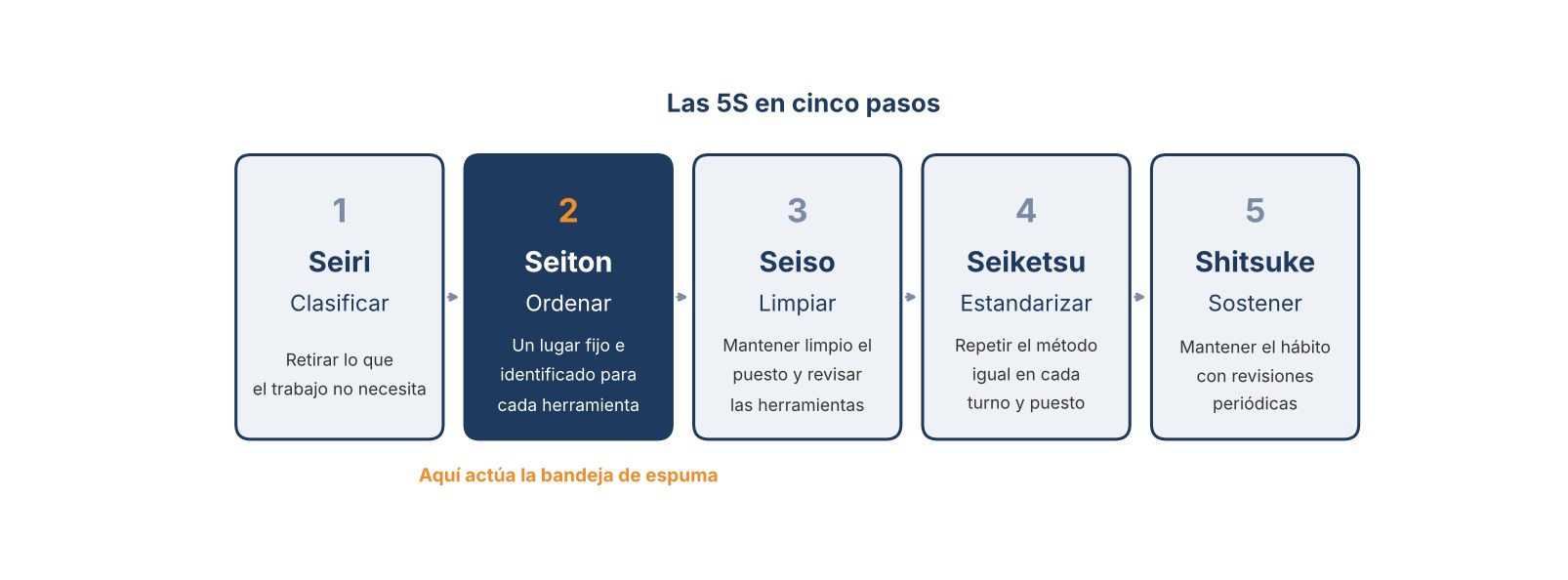
The 5S methodology in five steps. Seiton is the step implemented by the foam tool control tray.
Operators no longer need to remember where each tool is because they can see where it belongs. However, the tray alerts users to a missing tool; it does not prevent tools from going missing. Without a tool count at the beginning and end of each shift (Seiketsu), an empty cavity may go unnoticed for hours.
Layered foam or custom-machined tray
Peel-off layer foam, also known as Kaizen foam, is cut in-house. It is well suited to situations where the tool inventory changes frequently. When the inventory is fixed and the same layout is replicated across dozens of tool carts, a CNC-machined foam tray with precise dimensions for the drawer and each tool is a more cost-effective solution.
At ZFoam, we manufacture custom trays for all types of tool carts, tool kits and drawer inserts. Our process follows the industrial protective foam packaging design methodology, including prototyping and machining of each cavity. For two-colour trays, a laminated layer in a contrasting colour reveals the underlying surface whenever a tool is missing.
What a tool tray material needs to withstand
Azote® foams are manufactured using high-purity nitrogen injection and leave no chemical residues or ammonia that could affect tools. The range covers densities from 15 to 250 kg/m³.
According to the manufacturer, Zotek® foams resist a wide range of chemicals, including most solvents.
The surface features reinforcement to improve abrasion resistance. A sterilisation option is available for medical applications. The choice between cross-linked and non-cross-linked polyolefin foam affects the finish and durability of the cavities.
When the tray is part of a FOD programme
In the aerospace and defence industries, a tool left behind in an aircraft poses a safety risk. The AS9100 standard requires measures to prevent, detect and remove foreign objects, while AS9146, issued by SAE International, defines the requirements for a FOD prevention programme. In this environment, the tray is no longer simply an organisational improvement; it becomes an integral part of the control system.
What to define before ordering your trays
Before ordering a tray, gather three key pieces of information: the exact list of tools assigned to each drawer, the dimensions of the drawer or tool cart, and the point during the shift when the tool count will be carried out.
The foam’s ability to withstand the fuels, solvents and oils used in your workshop will determine the tray’s service life. Make sure this factor is considered when selecting the material.
Design your plant’s tool control system with ZFoam
Custom foam for tool carts, kits and tool inserts.
Tell us which tools you use and which cart or drawer they need to fit into. Our engineering team will recommend the most efficient drawer layout, the right foam for your working environment and colours that make every missing tool immediately visible.
Frequently asked questions about foam tool control trays
What does Seiton mean in the 5S methodology?
Seiton means Set in Order. It is the second step of the 5S methodology and assigns every tool a fixed, clearly identified and easily accessible position. A tray with a dedicated cavity for each tool puts this principle into practice.
Kaizen foam or a custom-machined tray?
Layered foam is cut by hand and is suitable when the tool inventory changes. A machined tray is manufactured to the exact dimensions of the drawer and each tool, making it the better option when the tool list is fixed and the same configuration is required across several carts.
Which type of foam is suitable for a tool control tray?
It depends on the working environment. Azote® is manufactured using nitrogen and leaves no chemical residues or ammonia that could affect tools. Zotek® resists a wide range of chemicals, including most solvents.
Can custom trays be manufactured for any type of tool cart?
Yes. ZFoam manufactures custom trays and inserts for all types of tool carts and tool kits, including two-colour versions with surface reinforcement. The tool list and drawer dimensions are all that is needed to get started.
Which standards govern FOD prevention in the aerospace industry?
AS9100 requires measures to prevent, detect and remove foreign objects. AS9146, issued by SAE International, defines the requirements for a FOD prevention programme. NAS 412, issued by the Aerospace Industries Association, provides industry guidance.