High-compression gaskets for military shelters and bunkers
A seal failure of just a few microns in a shelter’s perimeter gasket negates the filtration system’s overpressure, leaving the crew exposed to chemical agents.
In a combat scenario, survival depends on maintaining constant positive internal pressure—as required by specifications—and that pressure relies on the perimeter gasket. When the gasket fails, everything else fails.
Conventional elastomers do not hold up. Under high closure pressures, they suffer from elastic fatigue and lose performance after months of stowage (prolonged storage) at extreme temperatures. A crushed gasket no longer seals, regardless of the quality of the surrounding metalwork.
That is why we utilize the BISCO® L3-XX40 range of high-resilience silicones—a medium-density (465 kg/m³) microcellular polymer that recovers its original thickness after years of extreme compression and maintains the seal throughout the equipment’s service life.
| Engineering material | Nominal density | Residual deformation (ASTM D1056) | Behaviour during prolonged stowage |
|---|---|---|---|
| BISCO® L3-XX40 silicone | 465 kg/m³ | <5 % | Excellent long-term elastic memory |
| PORON® 4701-60 Very Firm polyurethane | 240 kg/m³ | 10 % (70 °C) | Firm, continuous elastic support |
| Standard cellular rubber (EPDM / neoprene | 150 kg/m³ | >40 % (irreversible collapse) | Accelerated fatigue and loss of seal integrity |
Collapse due to compression set in traditional gaskets
Armoured hatches on command shelters require high deflection force to counteract the torsion transmitted to the frame during transport across hostile terrain.
Subjected to constant closure, cellular rubber or neoprene gaskets undergo permanent flattening—a phenomenon known in the industry as “compression set.”. The material loses its dimensional memory, microscopic gaps emerge, and pressurized air escapes through them.
With BISCO® silicones, however, recovery force remains constant between -55°C and +200°C, maintaining over 95% elastic memory throughout the operating cycle, as verified by ASTM D1056 tests.
A factory-installed gasket continues to seal effectively two years later—whether in the desert or in temperatures of minus 40°C—without the need to readjust wedge closures in the field.
The reason lies in the physics of the material: open-cell foams rely on trapped air for recovery—air that migrates until the material loses its ability to rebound—whereas in BISCO® silicones, the polymer network itself performs this function.
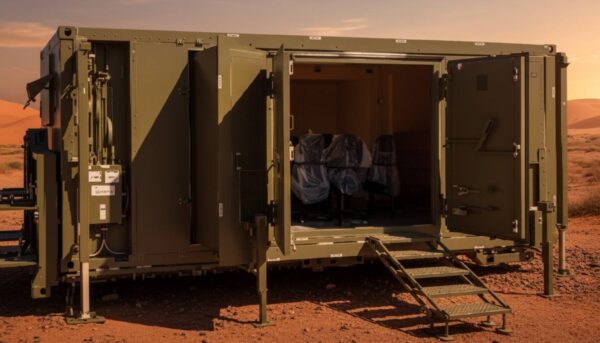
Outgassing: The Silent Enemy of Optronics
Chemically blown foams can retain process residues and release volatile organic compounds (VOCs) into the enclosure.
This outgassinggenerates vapours that condense on communications racks and fog up thermal and infrared vision sensors. In a shelter without forced ventilation, an ill-chosen gasket can compromise thermal vision capabilities long before any external threat does.
To eliminate this risk, we process Zotefoams’ Plastazote® polyolefins, which are expanded using pure nitrogen injection rather than chemical agents. Their closed-cell structure and chemical inertness prevent moisture absorption and gas emission, thereby protecting integrated circuit boards against corrosion caused by acidic condensation.
When extreme mechanical firmness is also required, we turn to PORON® 4701-60 Very Firm polyurethanes. These materials exceed ISO 6452 and DIN 75201 fogging test standards, ensuring that no volatile residues cloud the targeting or guidance optics. They contain no plasticizers and are non-corrosive to metal.
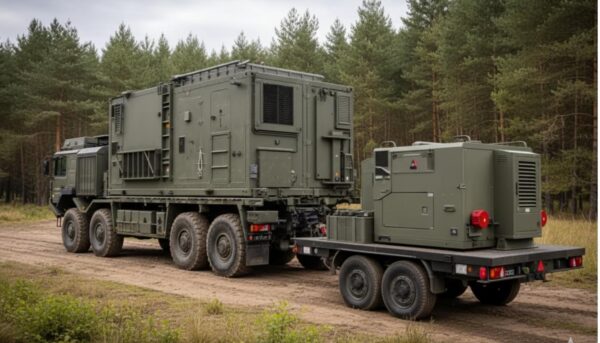
The Hidden Failure Vector in Bonded Joints
Tactical transport subjects the shelter to constant vibration and shear forces that stress any bonded joint.
A perimeter gasket made from strips mitre-bonded at the corners possesses a critical weakness: these joints eventually fail under frame torsion, creating an entry point for CBRN (Chemical, Biological, Radiological, and Nuclear) agents.
We solve this by machining continuous, single-piece gaskets—free of joints—directly from CAD designs.
- 2D and 3D CNC cold water-jet cutting. High-pressure water generates no heat, so it neither melts nor alters the polymer’s cell structure.
- Tolerance of ±0.3 mm along the entire perimeter.
- No vulnerable joints As there are no joints or liquid adhesives, the entire gasket maintains uniform density and elastic behaviour, including at the corners.
We supply them as ready-to-install kits, featuring the dimensional traceability required for the assembly of tactical dampers.
Reaction to fire for military specifications
International specifications are strict regarding flame spread and smoke emission in confined spaces, where ordinary elastomers release toxic gases and compromise evacuation.
BISCO® silicones meet the most demanding classifications, including grades certified under the European railway fire standard EN 45545-2 (Hazard Level HL3) for acoustic barriers and sealing, as well as the UL 94 V-0 rating (self-extinguishing with low smoke opacity).
Defence procurement boards are increasingly applying these thresholds to cabins and enclosed compartments.
We design the seal your specification requires
The reliability of an NBC (Nuclear, Biological, and Chemical) system allows for no compromises; it begins with a material choice that many integrators address too late.
Send us the CAD drawings of your hatch or frame, and we will prepare a perimeter elastic feasibility study based on your geometry, including polymer selection, deflection force, and machining tolerances.
ZFoam’s plant in Alfajarín (Zaragoza) is equipped for both pre-series and large-scale production, maintaining the traceability required by ISO 9001 and IATF 16949 standards.
Contact our engineering team, and let’s design the seal for your project.
FAQs about NBC sealing
Why does compression set compromise the overpressure of a tactical shelter?
Permanent deformation exceeding 40% causes a permanent loss of elastic thickness, nullifying the shelter’s overpressure. As the gasket flattens, gaps appear, allowing the pressurized air to leak out.
BISCO® L3-XX40 silicone, with a compression set of less than 5%, maintains uniform, airtight contact pressure, in line with NATO’s STANAG 4621 design criteria.
How does outgassing affect the shelter’s optronic systems?
Volatiles from chemically blown foams condense as an acidic film on thermal camera lenses and corrode rack electronics, reducing infrared visibility in combat.
Nitrogen-expanded Plastazote® polyolefins do not emit these compounds, thereby protecting sensors and circuits.
What are the advantages of continuous CNC cutting over gluing corner joints?
A one-piece gasket eliminates fatigue cracks associated with glued joints. Adhesive creates a rigid point that is vulnerable to the vibrations of military transport.
Cold water jet cutting profiles the exact shape from CAD designs, maintaining resilience and a tight seal around the entire perimeter.