Selecting the right material:
Let us start with the most critical point: in tactical protective equipment, foam is not merely ‘filling.’. It is part of the protection system. And that implies a truth which, at times, can be uncomfortable. You can choose the right material… and still “fail” if the component does not transform, integrate and perform as the product requires.
To make this point clear quickly, here is a quite common (and very costly) scenario. A manufacturer launches a knee pad that performs flawlessly in the laboratory. After a few weeks of use in the field, the component begins to lose its shape.. The user does not notice it on the first day. Nor on the second. But when the foam no longer regains its shape between impacts, the protection ceases to be protection.
Foam that does not regain its shape between impacts is not protective. It is simply taking up space.
At ZFoam, we determine ‘which material’ is the right one, but also on understanding why it fails, which variable is the key factor, and how it transforms to ensure real-world performance under actual conditions of use.
What makes XRD® foam different in tactical applications?
At ZFoam, we collaborate with Rogers’ XRD® foams and function as distributors and processors for this range
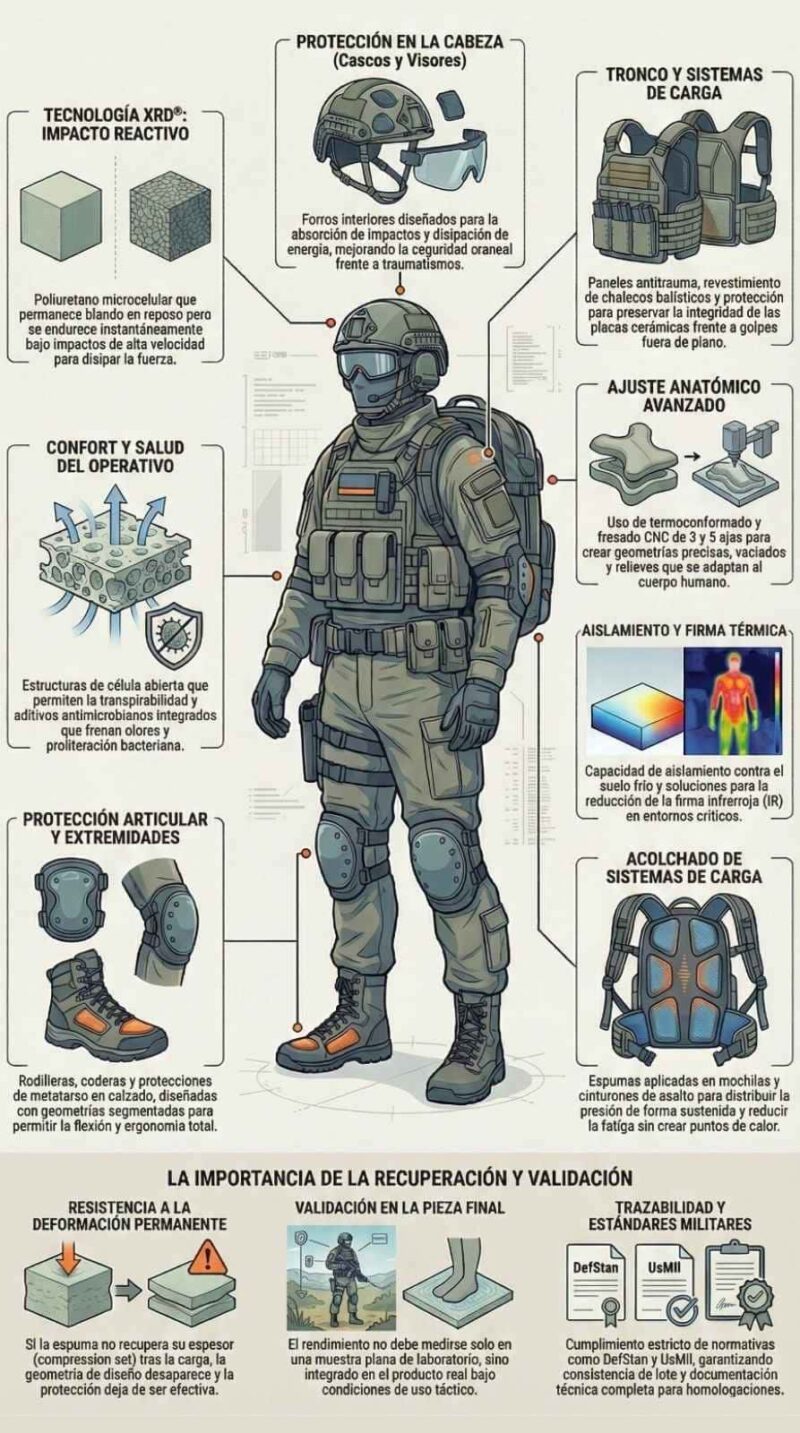
A foam featuring XRD® technology, which is the benchmark in this type of application, is a microcellular, open-cell engineered polyurethane with reactive behaviour. Soft and flexible at rest, it is capable of temporarily hardening under high-speed impacts, forming a ‘layer’ that helps dissipate the impact energy and reduce peaks in transmitted force (and acceleration).
XRD® Impact technology absorbs up to 90% of the impact force (ASTM F1614), but what is important for a development team is to understand under what conditions this performance is achieved: which is why it is worth framing it in these terms:
- the impact response depends on thickness,
- depends on the loading history (how it has been compressed previously: cycles, pre-loads, and time under pressure)
- and must be validated in the final part (i.e. verified through tests on the actual, fully integrated product), not just on a flat sample.
If we only talk about density and hardness, we are only telling half the story.
What is most underestimated when selecting this type of foam is not the density.
What is most underestimated when selecting this type of foam is not the density. It is the strain rate.
A foam can easily pass a ‘slow’ compression test and still be unsuitable for its intended use. In a real impact, the rate of deformation completely changes the behaviour of the polyurethane. If the material does not enter the correct regime (or does not recover sufficiently between events), the system degrades even if it meets the requirements ‘on paper.’
XRD® and other foams we use in tactical protection.
To be clear: XRD® is an excellent solution when you need high-speed impact mitigation with a low profile, but it is not the only foam that makes sense in tactical equipment.
At ZFoam, we work with a broad portfolio (polyurethanes, polyethylene, EVA, rubbers, and other technical materials) to address functions as diverse as impact, sustained compression, comfort, insulation, sealing, or transport protection.. The key is to choose the material based on the actual load and usage cycle, not out of habit.
Properties that are non-negotiable in a tactical environment
In addition to impact response, there are two properties that carry more weight in tactical protection than meets the eye:
- Breathability (open-cell) The open-cell structure allows air and moisture vapour to flow through. During long missions or intense activity, this translates into real comfort, less maceration, and less fatigue.
- Integrated antimicrobial protection In intensive use, the material is exposed to sweat, moisture, mud, and cleaning cycles. Having an antimicrobial additive helps curb the bacterial proliferation associated with odours and, worse still, the deterioration of the garment.
Added to this is a classic that always comes back. Resistance to permanent deformation (compression set). If the foam does not recover its thickness and shape after loading, your design geometry ceases to exist.
Four typical applications (and why they are not designed the same way)
In protective equipment, mixing requirements across applications is a direct source of failure. Let us take it step by step.
01 · Joint and full-body protection
Shoulders, elbows, forearms, hands, thighs, knees, ankles, feet.
- Repeated dynamic impact.
- Little leeway on thickness (often the design is already finalised by the time the material arrives).
- Need for flexibility and ergonomics
Geometry is key here. Channels, transitions, segmentation, and refined edges to avoid hard spots.
02 · Ballistic ceramic plate protection
Ballistic ceramics are highly effective against projectiles but can be vulnerable to off-axis impacts (falls, transport, handling). The foam acts as an absorption system to preserve the integrity of the plate.
t does not replace ballistic protection; it preserves it and extends its operational lifespan.
03 · Trauma pad or anti-trauma panel
It sits between the plate and the body. It reduces the energy transmitted when the impact is stopped by the plate.
It is one of the most sensitive applications, because the fit is very precise:
- Too soft → does not reduce energy transfer
- Too rigid → concentrates energy.
- Incorrect thickness → compromising the closure and ergonomics of the plate carrier.
Here, the specification cannot be generic; it is calibrated to the final design.
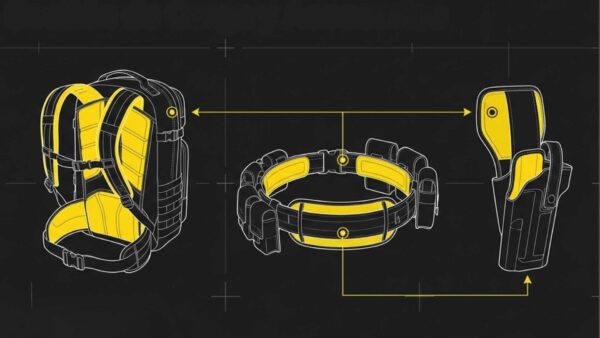
04 · Padding for load-bearing systems
Plate carriers, belts, assault rucksacks.
In this case, the material works primarily under sustained static compression (hours), not impact. The main requirement is to distribute pressure and reduce fatigue, without creating pressure points.
It is functionally distinct from other foams designed for vibration or structural noise (NVH) inside vehicle cabins, such as those we use in military vehicles.
Material formats and industrial processing
The raw material is the starting point. What determines the result of the component is the processing method.
On the market, this type of foam can be found in rolls or sheets in a range of thicknesses and densities, as well as in solution formats for moving parts (articulated structures with cut-out patterns) or specific protection for tactical footwear (for example, metatarsal protection).
Specifically, in the case of Rogers’ XRD®, it is typically used in:
- Flexible foam on a reel (open cell): highly breathable and designed to maintain a ‘cool and dry’ comfort; available in black and with evaluation support via samples.
- Articulated solutions such as Flexoskeleton®: a compact pattern to balance coverage and mobility in areas such as the knee, elbow, torso, or hands.
- Specific protectors such as metatarsal protection (Met Guard) for tactical footwear when the risk is to the top of the foot.
The key point: the chosen format determines the design, the stitching/lamination, and the final performance.
In a tactical project, what we usually decide early on is whether you need:
- a flat piece integrated into fabric, or
- an anatomical shape (contours, cut-outs, articulation), or
- a multi-layer component (foam + stiffener + fabric + technical adhesive).
Conversion or transformation processes (when to choose each one)
- Die-cutting: ideal for runs with repeated geometry; die-cutting is usually the most efficient method.
- 2D/3D waterjet cutting without heat input, useful when you want to minimise deformation or stress and maintain geometry in high-resilience foams.
- 2D/3D CNC milling: recesses, embossing, ergonomic contours. Particularly useful for anatomical parts and articulated protectors.
- Thermoforming: adaptation to predetermined shapes with process control.
- Lamination with technical adhesive: pre-bonded multi-layer, ready for in-line integration.
The key point is that the transformation process forms part of the specification.. If you do not define this alongside the material, the problem manifests in the final product and is difficult to diagnose.
Certification and technical
Approval processes (industrial, law enforcement, defence) demand not only performance but also documentation.
And this is where many projects stall: the material may work, but without traceability, batch consistency and a robust technical dossier, the manufacturer cannot proceed.
At ZFoam, we have the full suite of solutions to ensure the project does not get stuck halfway:
- Technical data sheets and material documentation with clearly described test and usage conditions (thickness, conditioning, and acceptance criteria).
- Batch traceability: identification of origin, incoming inspection, and verifiable consistency in production.
- Dimensional and process control during conversion (tolerances, repeatability, and records), to ensure the final part is consistent in series production.
- A testing plan geared towards real-world use (repeated impact, recovery, sustained compression and, where applicable, environmental conditions).
- Declarations of conformity aligned with the target standard for the final product, and support in preparing the technical dossier.
When the project requires enhanced traceability and documentary consistency throughout the supply chain, it makes sense to also consider the complete system (material + integration + transport). In that case, you will find this article especially useful: Comprehensive packaging solutions for defence and security.
How we work at ZFoam
The best projects begin before the design is ‘finalised.’
- You explain to us what you are building, the conditions of use and the actual requirements (thickness, ergonomics, integration).
- We propose materials and conversion or transformation processes consistent with the actual use.
- We send samples for validation under your conditions.
- We produce a pilot batch before committing to a production run.
- We assist with the documentation where the project requires it.
If you are developing or reviewing a tactical protection range, tell us where you are at and we will collaborate with you, technically and without beating about the bush.
→ Contact the ZFoam technical team Share it! Choose your platform