Several foam samples sit on a packaging designer’s table. They are all lightweight; they all promise protection and an impeccable presentation. Yet, one releases volatile organic compounds that could contaminate the product. Another fails the required transport test. And the third does not fit into the single-stream paper recycling system the brand wants to highlight on its packaging.
A poor choice leads to quality rejections, re-validation costs, and—in the worst-case scenario—a product recall.
ZFoam processes the five major families of technical foams found on the international market. This changes the conversation: the starting point is not the supplier’s catalogue, but the product’s technical requirements.

Plastazote® and the Azote® range: when purity allows for no compromises.
Azote® foams are expanded using high-pressure nitrogen. Zero chemical foaming residues. Zero volatile organic compounds. Zero hydrochlorofluorocarbons.
The resulting material is inert, hypoallergenic, odourless, latex-free, and transparent to MRI, CT scans, and X-rays. For pharmaceutical and medical device applications, this combination resolves concerns that would not even be addressed with other foams
The product range spans from lightweight grades (LD15, 15 kg/m³) to high density (HD80), with the option of incorporating flame retardant, conductive, or static dissipative additives.
When should you choose Azote®? When the product encounters skin, food, or biological samples. When the absence of outgassing components is required. When ESD protection or fire safety ratings are key to approval. When packaging needs to be reusable yet remain in perfect condition.
Cross-linked polyethylene: the top choice for premium packaging
Cross-linked polyethylene foams have long been the benchmark for presentation packaging. The reason is both visual and technical. Their cell structure—much finer than that of non-cross-linked foams—creates uniform surfaces that convey quality from the very first moment of contact with the product.
The deep black colour characteristic of these foams has become a visual hallmark of high-end packaging in the perfume, watchmaking, consumer electronics, and jewellery sectors. However, the range of available colours extends far beyond black. Any corporate or seasonal shade can be incorporated into the packaging design without compromising mechanical performance.
ZFoam works with LDPE, HDPE, and EVA bases in densities ranging from 25 to 250 kg/m³. This range covers everything from lightweight blocking and bracing to high-compressive-strength inserts. Processing options are extensive: the material can be machined, die-cut, laminated, and combined with finishes such as velvet or flocking, as well as bonded with facing materials or digitally printed, offering the same versatility as the rest of the product catalogue.
Their price-performance ratio makes them the default choice for projects requiring a premium finish—without the extreme purity requirements of Azote® or the “blue bin” recyclability of Papira®.
Non-crosslinked polyethylene: the foam driving industrial packaging.
These are non-crosslinked polyethylene foams manufactured via extrusion and gas expansion. While Azote® wins on purity, non-crosslinked polyethylene (PNR) wins on unit cost for high-volume production runs.
Grades range from 20 kg/m³ (lightweight protection) to 150 kg/m³ (high-impact cushioning). Closed-cell, impermeable, and chemical-resistant. 100% recyclable, with a density representing between 2% and 15% of the equivalent solid plastic.
This is not the foam you show off in a high-end unboxing video. It is the foam that ensures the product arrives intact at the assembly plant—part after part, pallet after pallet.
ZFoam ECO and BIO: audit-ready traceability
ZFoam was the first European company in the foam converting sector to obtain ISCC PLUS. certification. This is more than just a badge on a sales sheet; it represents complete traceability of the raw material’s renewable origins, verified through an audited mass balance approach.
The ECO line comprises recyclable foams. The ECO RCL grade incorporates a very high percentage of recycled raw material. The BIO line focuses on the polymer’s origin; the BIO PT, BIO PN, and LJ BIO grades are manufactured from certified forestry residues, used cooking oil, or sugarcane. They offer the same physical properties as standard material but with a negative carbon footprint.
Joining these is Ecozote®, which combines a nitrogen expansion process (Azote® purity) with 30–40% post-industrial or post-consumer recycled content.
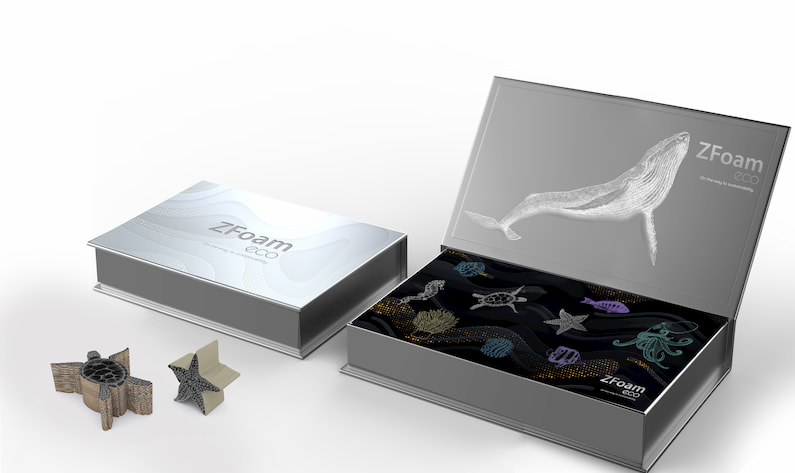
When should you choose ECO/BIO? When your client’s purchasing department demands objective data on carbon footprints or life-cycle analyses. When the supplier’s EcoVadis audit acts as a genuine qualifying criterion. ZFoam holds the EcoVadis Gold Medal (95th percentile, top 5% globally) and the MITECO Carbon Footprint Seal.
Papira®: the foam that goes in the blue recycling bin
Papira® is made from 100% cellulose fibre sourced from FSC-certified forests, in partnership with Stora Enso. It can be disposed of in the blue paper and cardboard recycling bin; it does not require a polymer recycling stream.
With a density of 30 kg/m³, the mechanical protection provided is equivalent to that of conventional polyethylene foams. It can be processed using the same CNC and waterjet cutting techniques as the rest of the product range.
Four questions to ask before opening the catalogue.
If the product comes into contact with skin, food, or biological samples, or requires ESD properties or a fire rating, Azote® is the right choice. It is the only product family that is completely VOC-free and offers certified flame-retardant and static-dissipative grades.
If the project calls for large-scale industrial protective packaging where unit cost is the deciding factor, choose non-crosslinked polyethylene foam in the 20 to 150 kg/m³ density range.
If the brand or end customer requires ISCC PLUS certification, verifiable recycled content, or a negative carbon footprint, opt for ZFoam ECO, BIO, or Ecozote®. The choice depends on whether the priority is price, certified bio-based origin, or Azote® performance combined with recycled content.
If the strategy involves packaging that the consumer can simply toss into the recycling bin alongside the cardboard box, choose Papira®.
Fabrication finishes (CNC machining, water-jet cutting, die-cutting, laser engraving, digital printing, velvet-touch lamination) can be applied to any product family. The finish does not limit the material choice, and the material does not limit the finish options.
One single converter, one single validation process
Purchasing departments in the perfumery, cosmetics, and pharmaceutical sectors often work with one supplier for conventional foams and another for sustainable materials. This results in two approval processes, two validation workflows, and two points of contact who each have only a partial view of the project.
Pressure from sustainability audits (EcoVadis, CDP, Scope 3) is set to consolidate the supply chain over the next 12 to 24 months. Each supplier adds complexity, and every material change between suppliers necessitates the re-validation of prototypes, technical specifications, and transport tests.
ZFoam processes Azote®, PNR, ISCC PLUS-certified ECO/BIO materials, Stora Enso’s Papira®, and recycled-content Ecozote®. All are handled on the same machining line, offering mould-free prototyping within 24–48 hours. If your project requires a technical recommendation, contact our team for a material analysis.
FAQs about packaging foams
What is the difference between cross-linked and non-cross-linked foam?
Cross-linking bonds polymer chains together. The result is a denser foam (starting at 25 kg/m³) with superior sealing capabilities and stable flexibility after thousands of compression cycles. Non-cross-linked foams are gas-expanded, range from 20 to 150 kg/m³ in density, and offer lower costs for high-volume production runs Full technical comparison.
Are ZFoam BIO foams biodegradable?
No. Their environmental advantage lies in the polymer’s origin (forestry residues and used cooking oil, ISCC PLUS certified) and their negative carbon footprint. At the end of their service life, they are recycled just like any other polyethylene. Differences between ECO, BIO, and biodegradable.
Is Plastazote® suitable for food contact?
Yes. Azote® foams are inert, non-toxic, and hypoallergenic. They are manufactured using nitrogen, leaving no chemical residues. ZFoam offers grades suitable for food contact in compliance with European and American regulations.
Which certification verifies the renewable origin of ZFoam ECO and BIO?
ISCC PLUS (International Sustainability & Carbon Certification). It verifies the complete traceability of the renewable origin through an audited mass balance system. ZFoam was the first European company in the sector to obtain it.
Does Papira® offer the same level of protection as polyethylene foam?
Stora Enso defines its properties as equivalent in terms of mechanical protection. With a density of 30 kg/m³, it absorbs impacts and protects fragile products during transport. The difference lies in the recycling stream, which is the same as that for paper and cardboard.
Does ZFoam manufacture prototypes without a mould?
Yes. We offer CNC machining and waterjet cutting for any product family in our catalogue. Functional prototypes are available within 48–72 hours. The same cutting program scales to mass production without changing the process.