A seal that loses its tightness, a support that flattens, or a component that detaches does not necessarily mean the wrong foam was chosen. The root cause may lie in the compression, the design of the housing, the adhesive, or the operating conditions. To resolve the issue, it is necessary to examine the entire assembly and evaluate how the installed component performs.
Foam Density Is Not the Whole Story
Density—expressed in kg/m³—is a useful parameter for identification and control, but it is insufficient for selecting a foam. The formulation, cellular structure, and manufacturing process dictate its mechanical response. Materials with similar densities can exhibit significant differences in terms of stiffness, recovery, and behaviour under load.
The choice should be based on compression resistance, recovery, and response under sustained or cyclic loading. Pressure values—typically expressed in kPa—are only comparable when the testing method, degree of deformation, and test conditions are identical. A compression curve provides far more insight than a single value found on a technical data sheet.
The selection criteria must align with the component’s intended function. For sealing, the priority is maintaining contact pressure; for impact protection, it is controlling transmitted energy; and for supports, it is limiting deformation under load. Prioritizing one property while ignoring other requirements may simply shift the point of failure elsewhere within the assembly.
Compression and Assembly Tolerances
Assembly compression must be defined based on the performance characteristics of the chosen foam grade and the available closing force. Nominal thickness, the geometry of the housing, and the contact surface area determine the operating conditions. The component must continue to perform its function throughout the entire anticipated dimensional range.
Insufficient compression can compromise sealing or securement. Excessive compression can increase the closing force, deform other components, and accelerate the loss of performance. The permissible range must be validated for each specific foam and application; generic percentage-based rules should not be used as a design criterion.
Dimensional analysis must collectively account for the tolerances of the foam thickness, the housing, and the mating surfaces. Extreme combinations can result in areas with no contact or excessive compression, even if the nominal assembly is correct. For large-scale gaskets, factors such as flatness, the distribution of attachment points, and pressure uniformity must also be evaluated.
Loss of Thickness and Loss of Force
Compression set (permanent deformation) is used to assess the recovery of thickness after a defined period of exposure. Insufficient recovery reduces the material’s ability to compensate for gaps or movement within an assembly. In gaskets subject to opening, thermal cycling, or dimensional variations, this loss can compromise contact and sealing integrity.
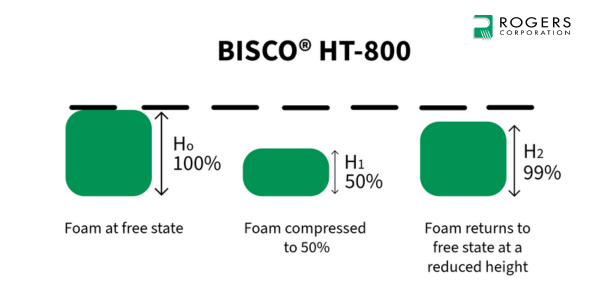
Diagram illustrating compression set in Rogers’ BISCO HT-800 foam, which recovers 99% of its original height after being compressed by 50%.
Results must be interpreted in the context of the relevant standard and test conditions—specifically the applied compression, temperature, duration, and recovery period. Differences in methodology and calculation references mean that published percentages cannot always be compared directly. A low figure, taken out of the context of its specific test protocol, does not in itself guarantee suitability for a given application.
Stress relaxation refers to the loss of force that occurs while a material is held under constant compression. This can reduce sealing pressure without any visible change in the gasket’s position. It should be evaluated alongside compression set, particularly in assemblies that remain closed for extended periods or operate at elevated temperatures.
Temperature and Environmental Exposure
The temperature of a component may be higher than that of the surrounding air. When selecting foam for use near a motor, a pipe, or a metal sheet exposed to sunlight, one must consider the actual contact temperature—including temperature peaks and their duration.

Solar radiation and heat on exposed surfaces increase the actual contact temperature experienced by technical foams.
Heat can promote deformation and a loss of force. The operational limits depend on the polymer, the formulation, and the applied loads. A maximum temperature specified in a technical datasheet does not guarantee that the foam will maintain all its performance characteristics under every possible compression scenario. Furthermore, a distinction must be made between continuous exposure and intermittent (or occasional) exposure.
Moisture, cleaning products, oils and solar radiation can affect the foam or its adhesive bond. Open-cell foams allow greater water ingress, while closed-cell foams generally limit it. However, the performance of the assembly also depends on the edges, joints and installation.
Validation should reproduce the relevant exposure conditions. If the component is subjected to repeated heating and cooling cycles, vibration or contact with liquids, testing each factor in isolation may not explain a failure that occurs when they are combined.
How to interpret a foam technical data sheet
Laboratory values are useful for comparing and selecting options, provided the test conditions are known. Before accepting a result, it is important to check the standard used, specimen thickness, applied compression, temperature, test duration and recovery time. Two percentages obtained using different methods should not be treated as equivalent.
Adhesive is also part of the solution
When diagnosing a bond failure, it is important to distinguish between interfacial separation, cohesive failure of the adhesive and tearing of the foam. Each failure mode points towards different variables that need to be reviewed: surface preparation and compatibility, adhesive strength or the internal strength of the material. Several failure mechanisms may coexist in the same component.
The location of the failure should be assessed in relation to the recorded force and the functional requirements. Foam tearing does not, by itself, demonstrate that the bond is sufficiently strong. Tests should be carried out on the actual substrates and finishes, under representative conditioning and, where appropriate, after the planned thermal, chemical or environmental exposure.
In pressure-sensitive adhesive systems, cleanliness, temperature and application pressure must be controlled, along with the time required for the bond to develop. Low-surface-energy plastics and certain coatings may require specific solutions. Selection should also consider peel and shear forces, as well as bond stability throughout the service life.
Cutting and manufacturing also have an impact
A well-designed component can fail if manufacturing affects its dimensions or damages the contact areas. Irregular edges, tears, deformation during cutting or defective lamination can compromise sealing performance and strength.
Quality control should cover thickness, outline, adhesive positioning and edge quality. If vibration or lateral forces are present, it is also necessary to check that the component does not shift or wrinkle during use. The prototype should be manufactured using a process representative of actual production.
Practical validation before mass production
Validation should link the material’s performance to verifiable requirements for the complete assembly:
- Define the function and acceptance criteria: sealing, cushioning or supporting a load, specifying what constitutes an acceptable result.
- Identify the operating conditions: temperatures, load duration, vibration, humidity and substances present.
- Check the installation: dimensions, tolerances, minimum and maximum compression, contact surfaces and adhesive.
- Test a representative prototype and assess its performance after the planned exposure conditions.
- Document the results and establish the manufacturing controls required to reproduce the validated solution.
Changing the foam may be necessary when its performance is insufficient. Before doing so, however, it is worth identifying the root cause of the failure. At ZFoam, analysing the application, component design and conversion processes helps us develop a solution that can be tested before mass production.
If a component fails in the field or needs to be validated before mass production, contact the ZFoam engineering team to discuss your specific application.
Frequently asked questions about technical foams
Why does a foam component fail even when the material is suitable?
The failure usually lies in the assembly rather than in the foam itself. Applied compression, housing design, adhesive and actual operating conditions all have as much influence as the material. That is why it is worth reviewing how the installed component performs before changing the foam.
Is density alone enough to select a technical foam?
No. Density, expressed in kg/m³, is useful for identifying and controlling the material, but its formulation, cellular structure and manufacturing process determine how it performs. Two foams with similar densities may differ in stiffness and recovery, so it is advisable to compare their compression curves rather than relying on a single data sheet value.
What is the difference between permanent deformation and stress relaxation?
Permanent deformation measures the thickness that the foam fails to recover after a defined compression cycle. Stress relaxation measures the force lost while the foam remains compressed. A gasket may remain in position and still lose sealing pressure, which is why both tests should be evaluated together.
How can you tell whether the adhesive or the foam is failing?
The first step is to examine where the failure occurs. Separation may take place at the interface, the adhesive itself may fail, or the foam may tear. Each case points to a different cause. Tests should be performed on the actual substrates and finishes, using conditioning conditions representative of service.
Why does the actual component temperature matter more than the ambient temperature?
Foam installed next to an engine, a pipe or a sheet of metal exposed to sunlight may operate at a higher temperature than the surrounding air. Material selection should consider the contact temperature, including its peaks and duration, and distinguish between continuous and intermittent exposure.
What needs to be validated before mass production?
It is advisable to define the function and acceptance criteria, identify the operating conditions, check dimensions, tolerances and minimum and maximum compression, and test a representative prototype. The results should then be documented and the manufacturing controls required to reproduce the validated solution established.